How Much Does It Cost to Charter a Private Jet in 2027?
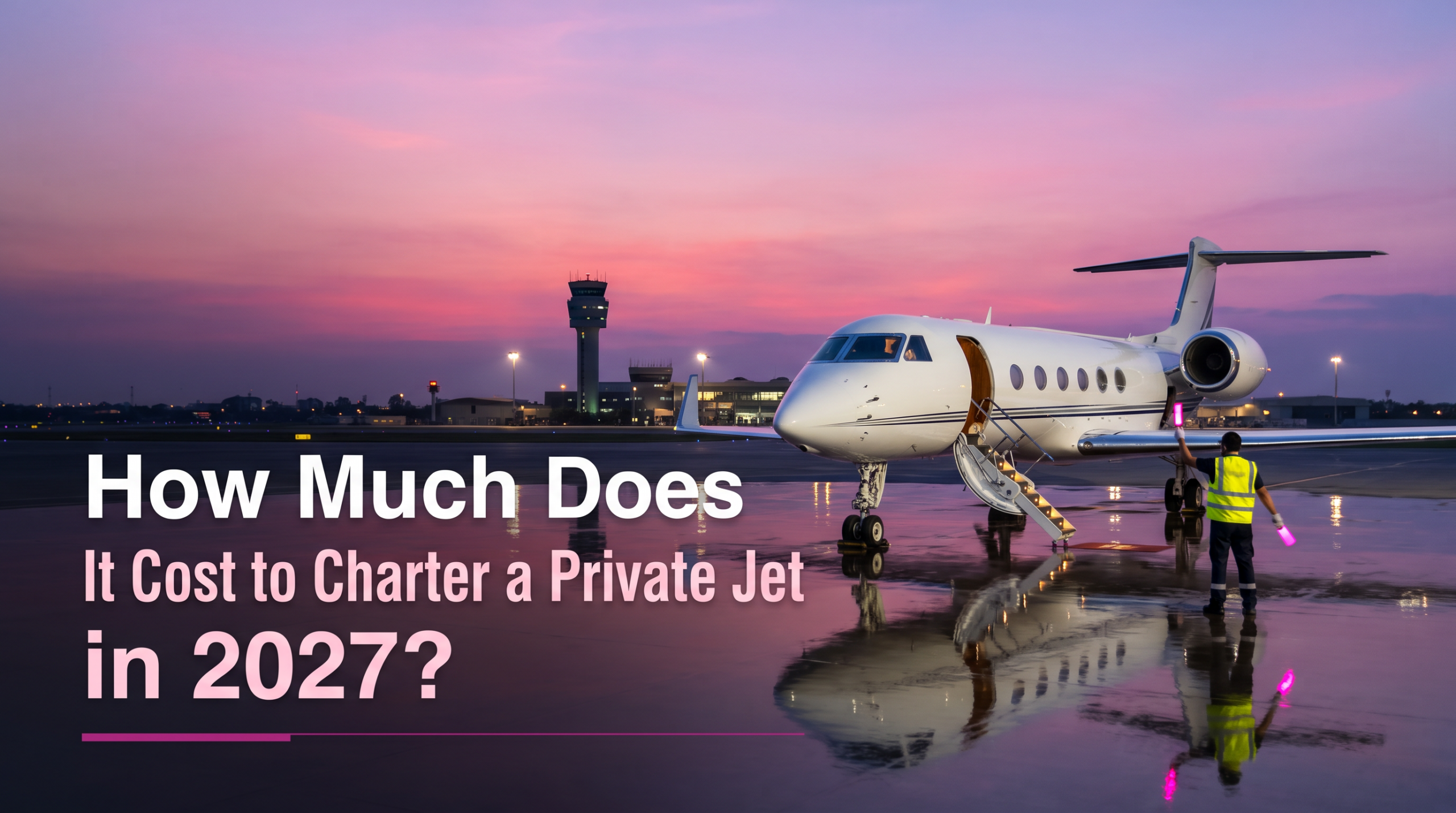
For decades, private aviation carried a simple image: a luxury only the ultra-wealthy could afford, priced behind closed doors. That has changed. Charter marketplaces, jet cards and transparent quoting have turned the question “what does it cost?” into one with real, publishable answers. Those answers still surprise first-time buyers.
As we head into 2027, the market is more mature, more price-aware and more sensitive to fuel and fees than it has been in years. The figures below are 2026 market rates, the most current data available, and they are the baseline for 2027 budgeting.
The Headline Number: Hourly Rates by Aircraft Category
Charter is almost always quoted per billable flight hour for the entire aircraft, not per seat. Published 2026 estimates put turboprops at roughly $2,000 to $3,000 per hour, light jets at $3,000 to $5,000, midsize jets at $5,000 to $8,000, super-midsize jets at $7,000 to $10,000, and heavy and ultra-long-range jets at $10,000 to $14,000 or more. At the very top of the market, VIP airliners can run roughly $16,000 to $23,000 or more per hour. blackjetviatravelers
Sources differ by a few hundred or even a few thousand dollars at each tier, depending on operator mix and region. Treat these as bands, not fixed prices. A light jet such as a Citation CJ3 typically falls between $3,500 and $5,500 per hour before fees, while a super-midsize like the Challenger 350 charges about $6,000 to $9,000 per hour. bladejettly
Why the Hourly Rate Is Never the Whole Story
The most common mistake first-time charterers make is multiplying the hourly rate by the flight time and calling it a budget. A real quote adds several layers:
Fuel. Fuel burn scales sharply with aircraft size. One 2026 guide estimates light jets burn 120 to 160 gallons per hour, midsize jets 190 to 250, and heavy jets 330 to 500 or more. The same source calculates that a three-hour midsize flight at $7.75 per gallon costs about $5,231 in fuel alone. When fuel prices spike, operators pass it on. In spring 2026, for example, some operators applied fuel adjustments of about $525 per flight hour for light jets and $650 for midsize jets. Flying Engineer +2
Positioning and repositioning. If the aircraft is not based where you are departing, or must return empty after dropping you off, you may pay for those legs. This is why one-way trips can cost more per mile than round trips.
Landing, handling and parking fees. These vary enormously by airport. Major business aviation hubs and slot-constrained airports cost more, and international trips add overflight permits, customs and ground handling charges.
Taxes and surcharges. Federal excise tax applies on many U.S. domestic charters, and international itineraries have their own tax regimes.
Extras. Custom catering, in-flight connectivity, de-icing, ground transportation and special aircraft requests all add to the total.
What Trips Actually Cost
Hourly rates only become meaningful when applied to real routes. One 2026 breakdown estimates a New York (Teterboro) to Miami (Opa-locka) flight of 2.5 to 3 hours at $15,000 to $20,000 in a light jet and $23,000 to $28,000 or more in a midsize jet, all-in. The same breakdown shows how fast the cost climbs with cabin size, with super-midsize and heavy jets on that route ranging from $25,000 to more than $65,000. Another guide estimates a New York to Los Angeles one-way trip in a super-midsize jet at $25,000 to $45,000. private charter flight costs +2
A rough planning formula is the hourly rate multiplied by billable hours, then add 15% to 30% for fuel adjustments, fees, taxes and extras. On international or multi-leg itineraries, budget toward the upper end.
The Seven Factors That Move Your Price
- Aircraft category. This is the biggest single driver. As one guide puts it, light jets cost less than midsize, which cost less than large-cabin and ultra-long-range aircraft. blade
- Route and distance. Longer flights cost more in total but often less per mile.
- Empty legs. Because the aircraft may fly back empty, one-way pricing is often steeper than it looks.
- Timing and seasonality. Holidays, major sporting events and peak summer or ski periods push prices up, and short-notice bookings carry a premium.
- Aircraft age and amenities. Newer aircraft with better connectivity and cabins command higher rates.
- Operator and certification. Safety audits, insurance and fleet quality are reflected in price. The cheapest quote is not always the best value.
- Airport choice. Using a secondary airport can cut fees and ground time.
How to Spend Less Without Flying Worse
Right-size the aircraft. Industry guidance consistently points to this as the fastest way to control cost. A light jet instead of a super-midsize on a short domestic hop can save thousands per flight hour for a small group. jettly
Look at empty legs. Aircraft repositioning without passengers are often sold at a significant discount, in exchange for flexibility on dates and routes.
Compare jet cards and memberships if you fly regularly. Fixed hourly rates and guaranteed availability can beat ad hoc charter for frequent flyers, though the prepaid deposit is a real commitment.
Get all-in quotes. Ask every operator or broker for a total price including fuel, fees, taxes and repositioning, and compare like with like.
Book early, and stay flexible. Moving departure by a few hours or a day can materially change the quote.
What to Expect in 2027
Anyone forecasting private jet prices should be humble, but several forces are clear. Fuel and operating costs remain the largest swing factor, as the 2026 fuel adjustments showed. Demand for private aviation remains strong among corporate, family and high-net-worth travelers, which supports rates, particularly on peak dates and popular routes. At the same time, online marketplaces and quoting tools are making prices more visible and comparable, which pressures operators to justify premiums. The practical takeaway for 2027 is to budget on the conservative side, ask for firm all-in quotes, and treat any fuel surcharge as a live variable until the flight is flown.
The Bottom Line
For 2027 planning, a reasonable shorthand is that small groups on short domestic hops should expect roughly $3,000 to $6,000 per flight hour before extras. Transcontinental and mid-range trips run $6,000 to $10,000 per hour. Long-haul, large-cabin travel starts around $10,000 and can exceed $20,000 per hour. Add a meaningful buffer for fees, fuel and repositioning.
The best price in private aviation does not come from the lowest hourly rate. It comes from matching the aircraft to the mission, being transparent about what is included, and working with an operator or broker you can trust.